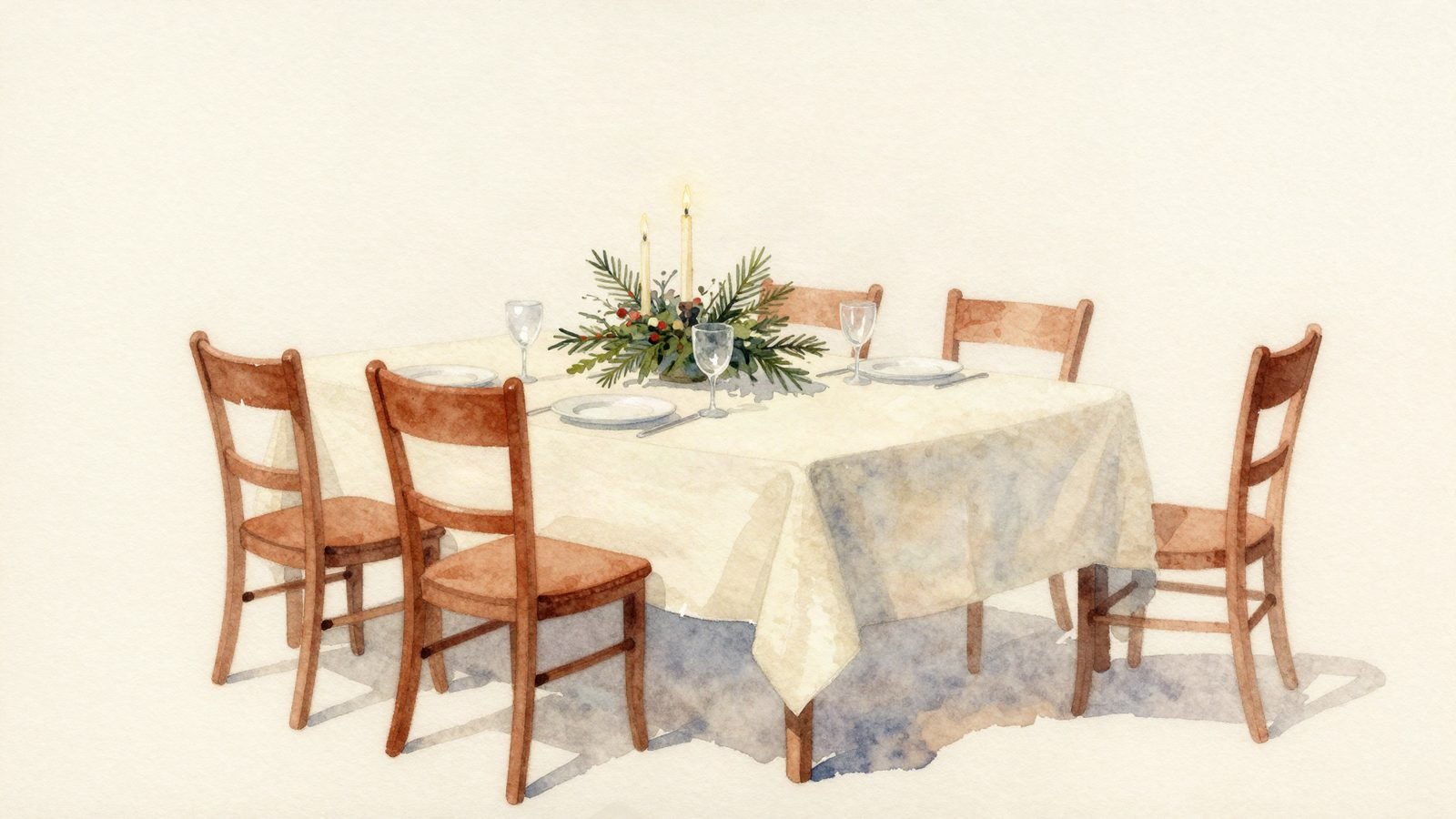
Everyone is finding their seats. Chairs scrape, someone is still in the kitchen, the gravy is going around. And then there is the one chair that nobody sits in, and nobody mentions, and everybody sees.
The short answer: The empty chair at a holiday table is one of the sharpest moments of grief, because it makes the absence visible. You do not have to hide it or fill it. Many Christians find comfort in naming the person, and in David’s words after his son died: “I shall go to him, but he shall not return to me.” The separation is real, and it is not permanent.
Why the chair hurts more than the day
Grief lives in geography. The side of the bed, the coat on the hook, the place at the table.
For most of the year you can arrange life so that you do not look directly at the absence. You take a different route. You leave the room. But a holiday meal puts everyone in their places at once, and there is one place that stays empty in front of everyone.
That is why the moment of sitting down is often harder than the whole rest of the day. It is the moment the absence becomes public.
Should we set a place for them?
There is no right answer, and families do this differently.
Some leave the chair empty and set a single candle or flower at that place. Some put a photograph there. Some move the chairs so there is no gap at all, because the gap is too much this year. Some families go to a restaurant for the first holiday, precisely so there is no familiar table.
What matters is that the choice is made on purpose, together if possible, and not left to happen by accident in front of everyone. A quiet conversation a week before saves a very hard moment at the table.
What David said at the empty place
When King David’s infant son died, David did something his servants could not understand. He got up off the floor, washed, changed his clothes, and went to worship. When they asked him how he could, he said this:
But now he is dead, wherefore should I fast? can I bring him back again? I shall go to him, but he shall not return to me.
2 Samuel 12:23, KJV
Two honesties live in that sentence, and both matter.
He shall not return to me. David does not soften it. There are no signs and no pretending. The person is not coming back to this table, and you are allowed to say so, because false comfort is not comfort.
But then the direction turns. I shall go to him. The separation is not a wall. It is a distance, and distances close. For the one who belongs to God, the road you are on ends where they are.
That is the quietest form of resurrection hope, and it is older than Easter by a thousand years. It will not fill the chair. It changes what the chair means.
If the house has gone quiet this year, I wrote twenty-four prayers for the days you have no words of your own, including one for when the house is too quiet. They are free.
Saying their name at the table
The hardest part of an empty chair is often not the chair. It is the silence around it. Everyone is being careful. Nobody wants to be the one who makes it sad.
But the missing person is already at the table in everyone’s mind. Saying the name out loud usually lets the whole room breathe.
You might say, before the meal, “I miss Dad today, and I’m glad we’re together.” You might tell one story. You might ask someone else to tell one. It does not need to be a speech. It needs only to break the silence that is pretending the chair is not there.
If you cannot sit at the table
Some years you cannot. That is allowed.
You can eat in the kitchen. You can arrive after the meal. You can spend the holiday somewhere else entirely and come back to the old table next year, or in five years. Grief does not follow a schedule, and neither does healing. Nobody who loved you wants you to prove you are fine by sitting in front of the empty chair before you can bear it.
A prayer for the moment you sit down
Lord, I see the chair. Everyone does.
I am not going to pretend it is not there, and I am not going to be able to look at it for long. Sit here with me. Be in this room in a way my body can feel.
Thank You for the person who used to sit there. I would rather have loved them and lost them than never have had them at this table at all.
And keep the promise David held: that this is a distance, not a wall. Amen.
Frequently asked questions
What is the empty chair tradition for grief?
Some families mark a lost loved one at holiday meals by leaving their chair empty, setting a candle or photograph at their place, or saying their name before eating. There is no required practice. The goal is to acknowledge the person rather than pretend the absence is not there.
How do you cope with an empty chair at Christmas?
Decide ahead of time, together, what to do with the chair, so the moment is not a surprise. Say the person’s name out loud. Give yourself permission to leave the table if needed. Many people find the anticipation harder than the meal itself.
What does the Bible say about seeing loved ones again?
In 2 Samuel 12:23, David says of his son, “I shall go to him, but he shall not return to me.” The New Testament develops this hope further in 1 Thessalonians 4:13-14, where Paul tells believers they do not grieve without hope, because those who die in Christ will be raised.
Keep reading
Written by Ellen G. Coyle, author of A Year at His Feet.
If you want a companion for the whole year, A Year at His Feet is 365 short readings for the woman who is still carrying something.
If you are thinking about ending your life or harming yourself, please call or text 988 to reach the Suicide and Crisis Lifeline. You do not have to carry this alone tonight.