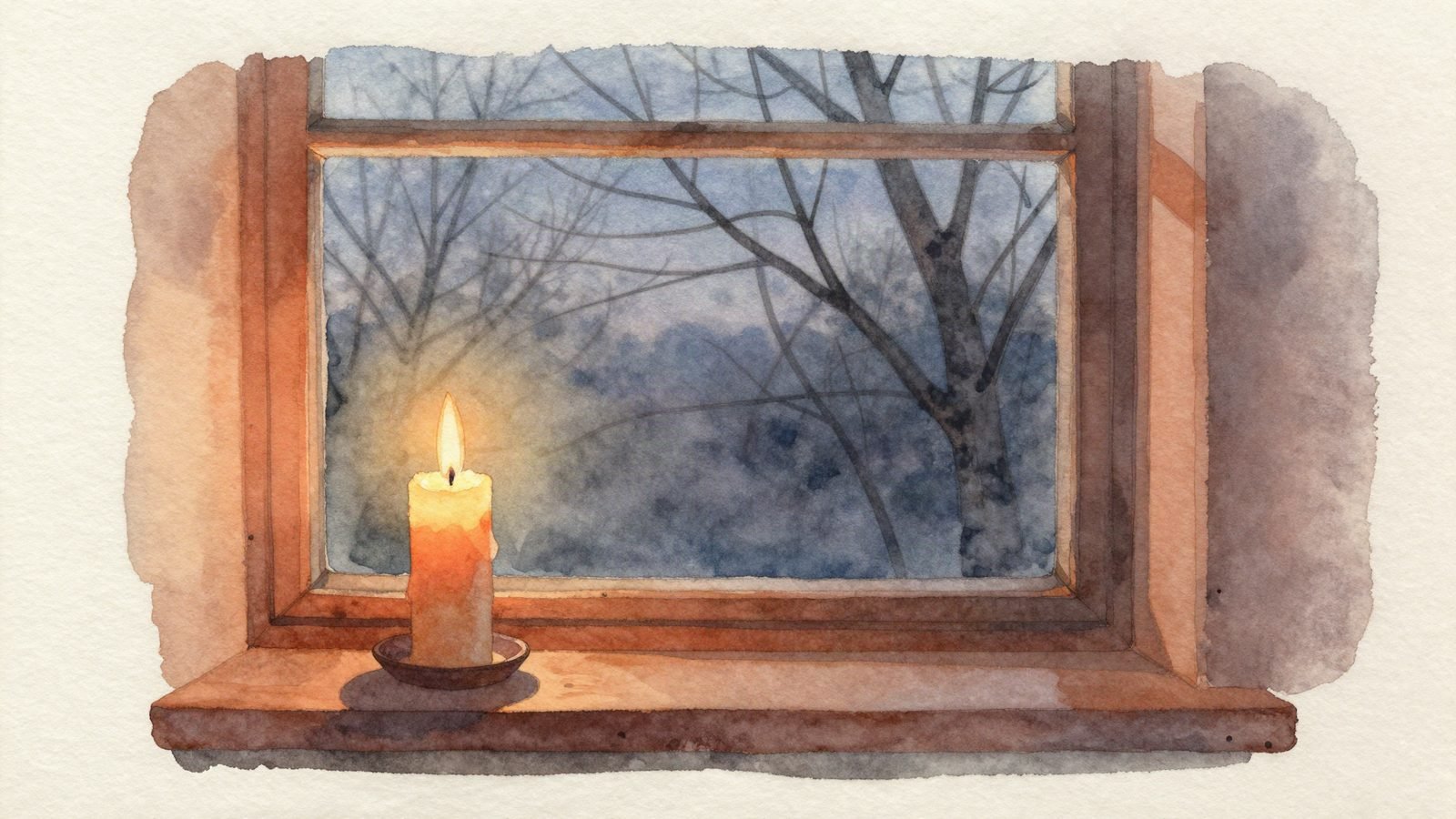
The decorations are still in the garage. You went out there twice this week and stood in front of the boxes, and both times you came back inside without opening them. One of them has handwriting on it that is not yours.
The short answer: The first Christmas after a death is usually hardest in the weeks before it, not on the day itself. You do not have to keep every tradition, feel festive, or be fine. Scripture does not ask grieving people to clean up their darkness before Christmas. It says the light came to the people who were still sitting in it.
Why the weeks before Christmas feel worse than the day
Almost everyone who has lived through a first Christmas after a loss says the same strange thing: the dread was bigger than the day. For three or four weeks your body braces. The music in the grocery store, the catalogs in the mailbox, the question at church about your plans. Each one lands on a bruise.
Then the day comes, and it is sad, and it is quiet, and it is survivable. By evening you are almost surprised you are still standing.
This is worth knowing in advance, because it changes what you prepare for. You do not need a plan to be happy on December 25. You need a plan for the first three weeks of December, when the anticipation does most of the damage.
Do I have to keep our traditions this year?
No. And you do not have to drop them either.
Some traditions will comfort you precisely because they carry the person with them: the recipe made in their honor, the ornament hung in their spot. Others will be unbearable this year and fine again in three years. You will not know which is which until you are standing in front of them.
So give yourself permission to decide late. Keep a short list of what you will do and a longer list of what you might do, and let the long list shrink without apology. Nobody who loved you would want you to perform a Christmas you cannot feel.
What Scripture says to people who are still in the dark
There is a verse the church reads every December, and most of us have heard it so many times that we miss where it is aimed.
The people that walked in darkness have seen a great light: they that dwell in the land of the shadow of death, upon them hath the light shined.
Isaiah 9:2, KJV
Look at who receives the light. Not the people who found their way out of the dark first. Not the ones who pulled themselves together in time for the holidays. The people who walked in darkness. Those who dwell in the shadow of death: live there, resident, not visiting.
The whole Christmas story is aimed at that address. God did not wait for a lit room. He came into the one that was dark, and He still does.
This matters more than it sounds, because grieving people often feel that Christmas is a party they have been disinvited from. It is the opposite. If you are sitting in the shadow this year, you are exactly who the verse was written for.
If you are in a season like this, I wrote twenty-four prayers for the days you have no words of your own, including one for the day after the funeral and one for the anniversary you have been dreading. They are free.
How to get through the first Christmas without them
A few things that tend to help, gathered from people who have been where you are.
Tell people what you need before they guess. Most of the people around you are frightened of saying the wrong thing, so they say nothing, or too much. A short message helps them: “This year I would like to talk about him,” or “I may leave early, and that will be fine.”
Name the person out loud. The silence around a name is often heavier than the name. Say it at the table. Tell one story. You will not ruin Christmas by remembering who is missing from it.
Plan an exit. Give yourself a quiet room, a walk, a drive. Knowing you can leave makes it easier to stay.
Let the tears have the day too. Laughter and weeping can live in the same afternoon. One does not cancel the other.
Keep one small thing that is only yours. A candle lit before anyone else wakes up. A few minutes with a verse. Something that is not for anyone else’s comfort.
A prayer for the weeks before Christmas
God, the season is coming whether I am ready or not, and I am not ready.
Everyone around me is getting festive, and I am trying to get through the grocery store without crying at the music. I do not know how to do this Christmas. I only know how to do this afternoon.
You came into the dark on purpose. Come into mine. Not after I have made it presentable. Now, the way it is.
Stay with me through the weeks before the day, when the dread is loudest. And on the day itself, sit at the table with me. Amen.
Frequently asked questions
Is it normal to dread the first Christmas after a death?
Yes. Dread before the first Christmas is one of the most common experiences of early grief. Many people find the weeks leading up to the holiday harder than the day itself, because anticipation keeps the body braced for a long time. Planning for those weeks, not only for the day, usually helps.
Should I skip Christmas this year?
You are allowed to scale Christmas down, change where you spend it, or keep only the parts that comfort you. Skipping it entirely sometimes makes the absence louder later. A smaller, honest Christmas that makes room for grief is usually gentler than either full celebration or full avoidance.
What does the Bible say about grieving at Christmas?
Isaiah 9:2 says the light came to “the people that walked in darkness” and those who “dwell in the land of the shadow of death.” Christmas is not a celebration for people who have finished grieving. It is God coming into the dark while people are still living in it.
Written by Ellen G. Coyle, author of A Year at His Feet.
If you want a companion for the whole year, A Year at His Feet is 365 short readings for the woman who is still carrying something.
If you are thinking about ending your life or harming yourself, please call or text 988 to reach the Suicide and Crisis Lifeline. You do not have to carry this alone tonight.